Friday, March 28, 2014

Our Month Through Sara's Eyes

Our month in San Cristobal is coming to an end and Gary has been after me to write down my feelings about living in Mexico. I have been keeping a daily journal of our comings and goings, which I have enjoyed doing.
It is a bit difficult to condense almost thirty days in to a few paragraphs. But I will try my best.

It was a bit of a culture shock for me when we first arrived in San Cristobal. Not speaking the language was a challenge.  I had taken some classes at PCC this past fall, but the few phrases I knew were not enough to make myself understood, or to understand what was being said to me. And they talk way too fast! I was glad that Gary was here to do the communicating for us. It was a bit lonely for me at times.Well, I just will have to take some more Spanish classes when I get home.

I also had trouble with the altitude here. At 7000 feet my body has had difficulty adjusting to it. The first week we were here I had a headache, nausea and was short of breath. The first two symptoms have gone away, but I still feel a bit out of breath when walking up hills. I saw a man jogging the other morning and wondered how he could do that? My goal to take a brisk long walk each day had to be altered somewhat.
Long slow walks have been my excercise while we have been here.


I have grown to love this beautiful city. It was more that we thought it would be. We had never been to this part of Mexico, and after having lived here would like to come back. It is a lovely colonial city with many old buildings, gardens, plazas and lots of friendly people. Everyone we have met has been so kind and helpful. I love when perfect strangers say hello to you as you walk by. And everywhere you see families out together, parents and children enjoying being with one another.

Our little adobe house is old and a bit rustic. It looks great in pictures, but lacked some of the amenities of home. The tiny kitchen has a gas stove lit with matches and a small fridge and freezer. Kitchen items were sparse, but we made do. I bought a piece of vinyl tablecloth fabric to cover the kitchen table so we would have more space for preparing our food. The fireplace came in handy most nights to heat the house, no central heating here. Adobe construction is perfect for the hot climate of most of Mexico; but, it makes for a cool and somewhat damp environment here. We hang our bath towels outside in the morning to dry in the sun.


I will miss the sounds I hear each day from our garden and the street outside our gate. The truck that delivers our big water bottles plays the song "Rain drops keep falling on my head", the gas trucks with the cylinders of propane gas, drag a heavy chain behind to ground any static electricity that might spark and cause an explosion. There are people selling things from door to door. We bought garlic from an old man who came into town from his ranchito. The neighbor's dog is let out in the mornings and evenings; the bark reminds me of our dog Tieka. We can hear the school band practicing in the afternoons, drums and trumpets. Children playing on the school grounds.Various birds singing in the trees in our garden. Roosters crowing at dawn. and the tolling of the church bells; always the tolling of church bells.


I love the bright colors that surround us each day. The tile roofs and colorful houses. Gardens with flowers and trees in bloom.The beautiful clothes that the indigenous people wear, even the little girls dressed in miniature like their mothers. Darling brown skinned babies smiling out from the shawls on their mother's backs. The men dressed in more conventional clothes. The markets full of produce and vendors selling at their stalls.The man with a box on his head full of cups of fresh squeezed juices. The craft market full of colorful treasures. A sensory overload!


There are the poor in this city, and we are approached by many women and children with things for us to buy. Gary is firm about saying No and walking away. I have a softer heart.  More than once I was tempted to buy some little thing from a small child, but  wasn't carrying any change at the time. When we were on our trip to the jungle last week, I did buy some fried bananas from a little Mayan girl. I had some US dollar bills in my wallet and gave her one of them. She wanted some pesos, but the dollar would have to do. I hope someone was able to give her twelve pesos for it.  Of course, we did not eat the chips.


It has been a wonderful time for Gary and me to be together. He loves Mexico and its people.  What better way to celebrate his retirement than to spend a month here in San Cristobal.


Wednesday, March 26, 2014

Los Mormones en Mexico

I am going to write about the LDS church in Mexico; so, again I apologize in advance to friends not of our faith for the Mormon jargon that follows.

Activity in the church, obviously, plays a big part in our lives; it was being assigned as a missionary to serve in Mexico in 1965 that began my love affair with this country.  We have enjoyed very much being able to walk to church each Sunday.  We were welcomed by the local members with open hearts and arms.  The second Sunday here Sara was greeted with a kiss from one of the little girls as we entered the chapel.  We quickly felt part of the ward family.
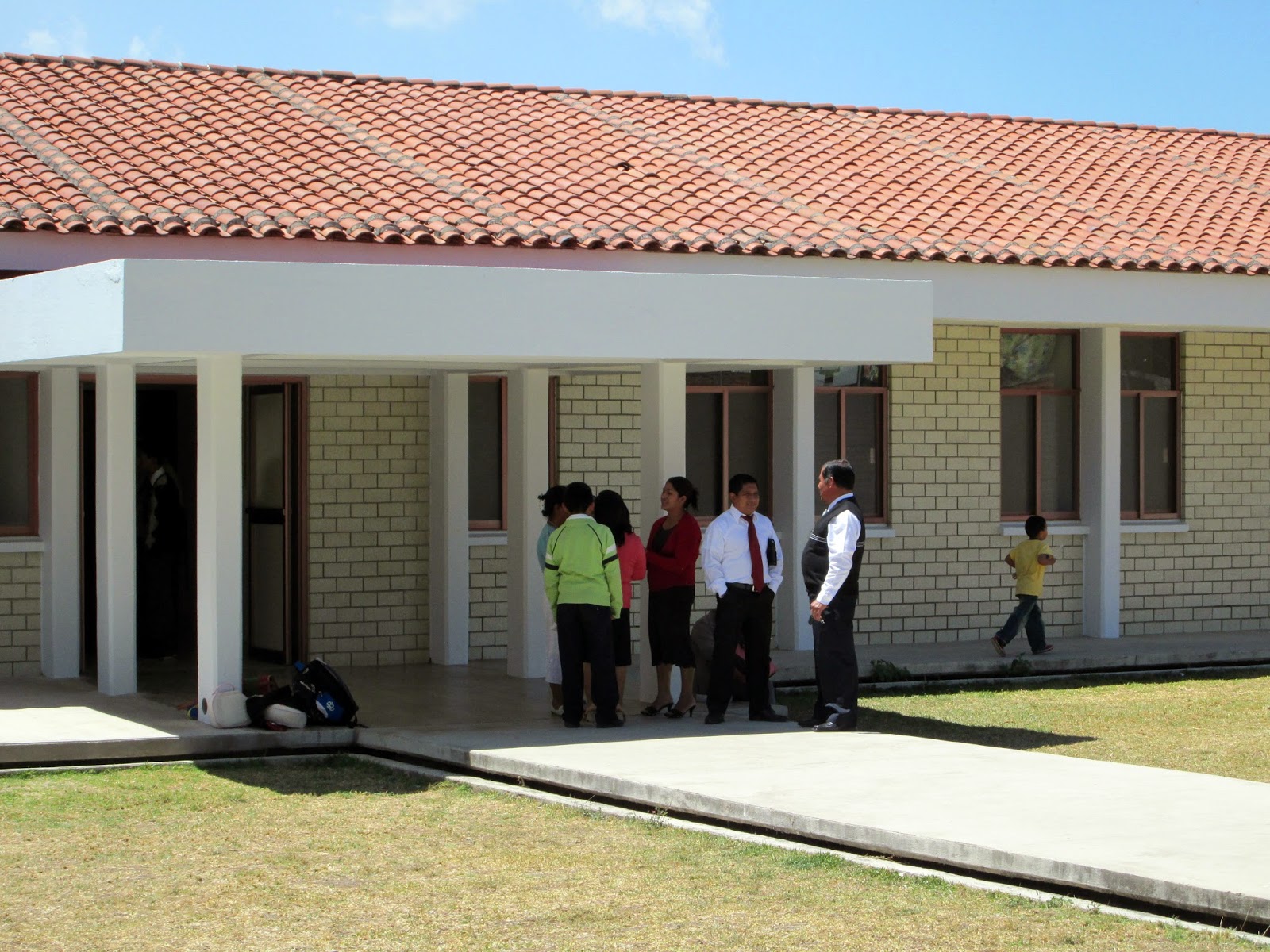
Our chapel, about a 15 walk from our house
Greeting one another as we arrive for Sacrament Meeting
Chatting at the end of the services
Sister Sheridan visited one Sunday.  As an RN, she was
volunteering at a hospital for two weeks repairing
cleft lips in infants.  She was from Ogden.  Her son served in the
 Armenian Mission at the same time that Kathryn
was there in the Peace Corps.
One of these sweet little hermanitas kissed Sara's cheek as
she shook her hand and welcomed us to her ward.

There is one gringo family in the ward, the Christensen's.  Andrew is actually from Denmark and his wife Ann is from Salt Lake City.  They have two little children and have lived in San Cristobal for over three years.  Ann's family started a NGO that works with the Mexican government to build schools.  Andrew is the in-country director for them.  We were impressed with the work they are doing.  Here is the link to their website.

Escalera

There are three wards in San Cristobal; one that meets in our building, and two that meet in the stake center across town.  There are several more wards and smaller branches in other towns that make up the San Cristobal de las Casas Stake.  We are in the Mexico Tuxtla Gutierrez Mission and there is a small temple in Tuxtla Gutierrez, the state capital, about and hour's drive away.  There are two sets of missionaries assigned to our ward, one gringo and three Mexican elders.  We met two sister missionaries in the plaza one evening assigned to one of the other wards.

The San Cristobal de las Casas Stake Center
Hermana Park from Salt Lake and Hermana Lara from Tampico

Sunday attendance in our ward seemed to be around 75 people; some who are there one Sunday are not the next.  I asked one elders about the activity rate.  He said maybe 33%.  Brian Appel, who served a mission about five years ago in the Mexico City suburbs, told me he thought it was closer to 10% where he was.  It kind of depends how you define "active".  Nevertheless, those who are there bare strong testimony of the gospel in there lives.  They love it, and it shows.  There was one young brother who had just returned in February from serving a full-time mission in Peru.  The talks in sacrament meeting and the lessons in Gospel Doctrine class and in Priesthood and Relief Society were all well presented.  Many of the ward members were following along in the scriptures on their smart phones or tablets.

The church has grown tremendously in Mexico since I was a missionary 49 years ago.  In 1965 Mexico's population was around 45 million; in 2012 it was 120 million.  I am not completely sure what church membership was in the mid-sixties; but, we always said it was around 40,000.  I found on the internet that in 1960 it was 13,000 and had grown to 68,000 by 1970, so our estimate is in the ball park.  I like to think I played some small part in that decade's growth.  Today, the official church membership in Mexico is reported at around 1.3 million, a significant increase in 50 years; although other evangelical churches and the Seventh-day Adventists and the Jehovah's Witnesses have had sharp growth also.

When I entered the Northern Mexican Mission, with its headquarters in Monterrey, I entered one of just four missions in all of Mexico.  The other three were the Western Mexican Mission headquartered in Hermosillo, the Southeastern Mexican Mission headquartered in Veracruz, and the Mexican Mission headquartered in Mexico City.  Our mission was huge.  It bordered the United States on the north and the Gulf of Mexico on the east.  It stretched from Tampico in the southeast, west across the states of San Luis Potosi, Aguascalientas, Zacatecas and Durango, then north through Chihuahua to Ciudad Juarez across the border from El Paso Texas.  My first change was from Ciudad Mante, near Tampico in the southeast corner of the mission, to Ciudad Juarez in the northwest corner.  It took me 32 hours on three buses and covered over 1000 miles, all by myself.  What was one mission back then is now at least ten separate missions.

When I left the mission in 1967, there were still only two stakes in all of Mexico.  One was the Anglo stake in the Mormon Colonies in Chihuahua where we did not even have missionaries, and the other was the Spanish speaking stake in Mexico City.  Everything else was mission field branches and districts.

There, obviously, were not any temples in Mexico back then.  The closest temple was in Mesa Arizona.  It was almost impossible for a member in San Cristobal to go to the temple.  It required a two-thousand-mile bus trip of at least 36 traveling-hours each way.  Few had been to the temple, as it was financially beyond the reach of most members.

In the 1960's we did not believe there would ever be a temple in Mexico.  At that time the Mexican constitution stipulated that all church buildings belonged to the state and be open to everyone.  This was a reaction to influence of the Catholic Church prior to the Revolution of 1910.  It seemed a miracle when the Mexico City Temple was dedicated in 1983.  There are now twelve operating temple in the country.

Mexican laws at the time affected us as missionaries in other ways.  The constitution prohibited foreign nationals from preaching religion in Mexico.  Again, an effort to reduce the influence of the Catholic Church.  Consequently, as Mormon missionaries, the visa that was issued to us by the Mexican government did not say we were representing The Church of Jesus Christ of Latter-day Saints.  Instead, it said we were "teachers of morals" representing the Young Men's Mutual Improvement Association.  We could not preach on the street corner; but, we did a lot of tracting.  And, we did not wear name tags; of course, in the sixties, no missionary anywhere wore name tags; they had not been invented yet.  The Mexican government knew exactly what we were doing, and it was okay with them.  That's why they issued us the visas.

So, logistically, legally, and operationally the church is much different today than half a century ago.  But what hasn't changed is the dedication, love and sweet spirit of the Mexican saints.


Tuesday, March 25, 2014

Doing the Things that We Have Put Off

Now that we are in our last week, we can no longer put things off until later.  Later is here.

Yesterday, Monday, we went up the other hill in town with a church on it.  The first week we went up the hill on the east, yesterday we went up the hill on the west.  Once again, we took a taxi up and walked back down.  It was sunny, pleasant in the shade and very peaceful, with few others there.  The church of San Cristobal , the Martyr, has clean, simple lines.


The "other" church on a hill in the distance
Looking back up the stairs.  That's why we
took a cab up.
Next to the church there was a series of exercise stations.  Let's see those Curves ladies in Portland do these at 7000 feet!


In the afternoon yesterday we went to visit the Taller Lenateros.  This is an organization that produces hand-made paper and books of amazing quality.  It is mostly indigenous people that work there.  They encourage visitors to tour their facility and they have a sales room filled with their work.  I would have loved to have brought home several posters if we only had wall space.  I encourage a visit to their website, which is in both Spanish and English.

 Taller Lenateros


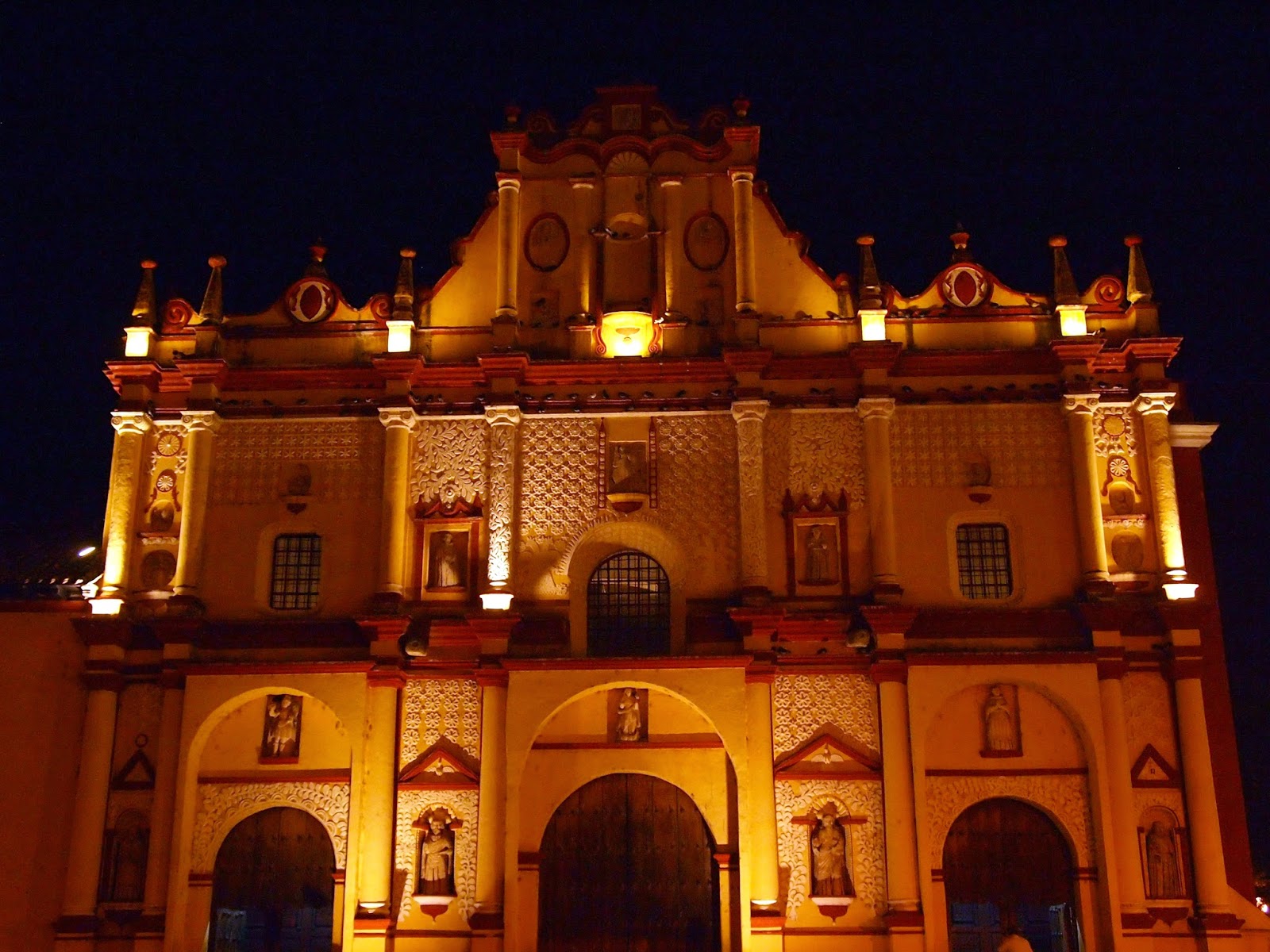
Ever since we arrived here I have wanted to take some photos of the cathedral after dark; however, every time we had gone to the zocalo at night, the lights that illuminate its facade were not on.  So, when we walked downtown last night and it was lit up, I was very excited.  I also did not have my camera with me.  So I left Sara sitting in the plaza while I hurried back home to get my camera and tripod.  Here is why I wanted to photograph it.


After shooting the cathedral, I walked to the other end of the plaza to take a picture of the small chapel down there.  I sat down on the sidewalk and set up the tripod; just as I was about to snap the photo, this couple walked into my field of vision, stopped and began smooching.  They didn't even know I was there.  After taking the picture, I got up and walked over to show them what I had taken.  They thought it was great!  Ay!  Los enamorados!

Today, Tuesday, Sara and I got a taxi to take us back to the town of Chamula and then to the town of Zinacantan.  When we visited Chamula during Carnival, the first week here, we were not allowed to take any photos.  I wanted to get some pictures of the town and its unique church.


It was on the porch under the restaurant sign that we
sat and watched the sea of people, and the bulls, when we
were here for Carnival.
This entire open space in front of the church was packed
with Chamulans in traditional dress the day we were
here before.

We only stayed in Chamula a short time, then the taxi driver took us on to Zinacantan on the other side of the mountain.  I had him leave us there; we would take a combi back to San Cristobal when we were ready.

The people of Zinacantan speak the same tzotzil Mayan as those in Chamula; but, their dress and traditions are very different.  They are also a more open, friendly people.  The women from Zinacantan are the ones who wear the beautiful lavender-purple-blue capes and blouses.  When we got out of the taxi, a girl with a toddler ask us if we would like to visit a co-operative of women who weave and sew the traditional clothing of Zinacantan.  We said yes and followed her to their workshop.

The workshop was down steps off the street in very
humble accommodations.


After spending time with these humble, sweet and very talented women and their children, and after buying a beautiful table runner, we walked back to visit the center of town and the church there.  As with the church in Chamula, photography in the church in Zinacantan was prohibited.  The inside of this church was much more orthodox than the one in Chamula, with pews and no pine boughs on the floor.  There did not seem to be the mixing of the old religion with Catholicism as much as in Chamula.  It was filled, though, with masses of flowers everywhere.  Zinacantan has a thriving flower-growing industry with many large greenhouses around the edge of town.


When we were getting ready to find the combi back to San Cristobal, we ran into the girl who originally took us to the women's co-op.  As we talked to her we discovered that the little two-year-old was not her little sister.  She was her daughter.  We we asked her how old she was she say, seventeen!  She was how old when she had that baby!  How old when she got married!  She said her husband works in the greenhouses.